How Drones Became One of the Most Important Technologies on Modern Battlefields
Not long ago, military drones were largely associated with expensive surveillance aircraft and sophisticated systems operated by major military powers.
That picture has changed dramatically.
A small drone that can fit into a backpack can now provide soldiers with a view of a battlefield that would previously have required aircraft, helicopters or large reconnaissance teams. Other unmanned aircraft can carry explosives, attack targets hundreds of kilometres away or continue operating even when traditional navigation and communications systems are disrupted.
Nowhere is this transformation more visible than in the war in Ukraine, where drones have become deeply integrated into reconnaissance, targeting, electronic warfare and strike operations. Research from the Australian Army Research Centre describes the change as a shift toward persistent battlefield surveillance, with unmanned aircraft operating across tactical, operational and strategic levels.
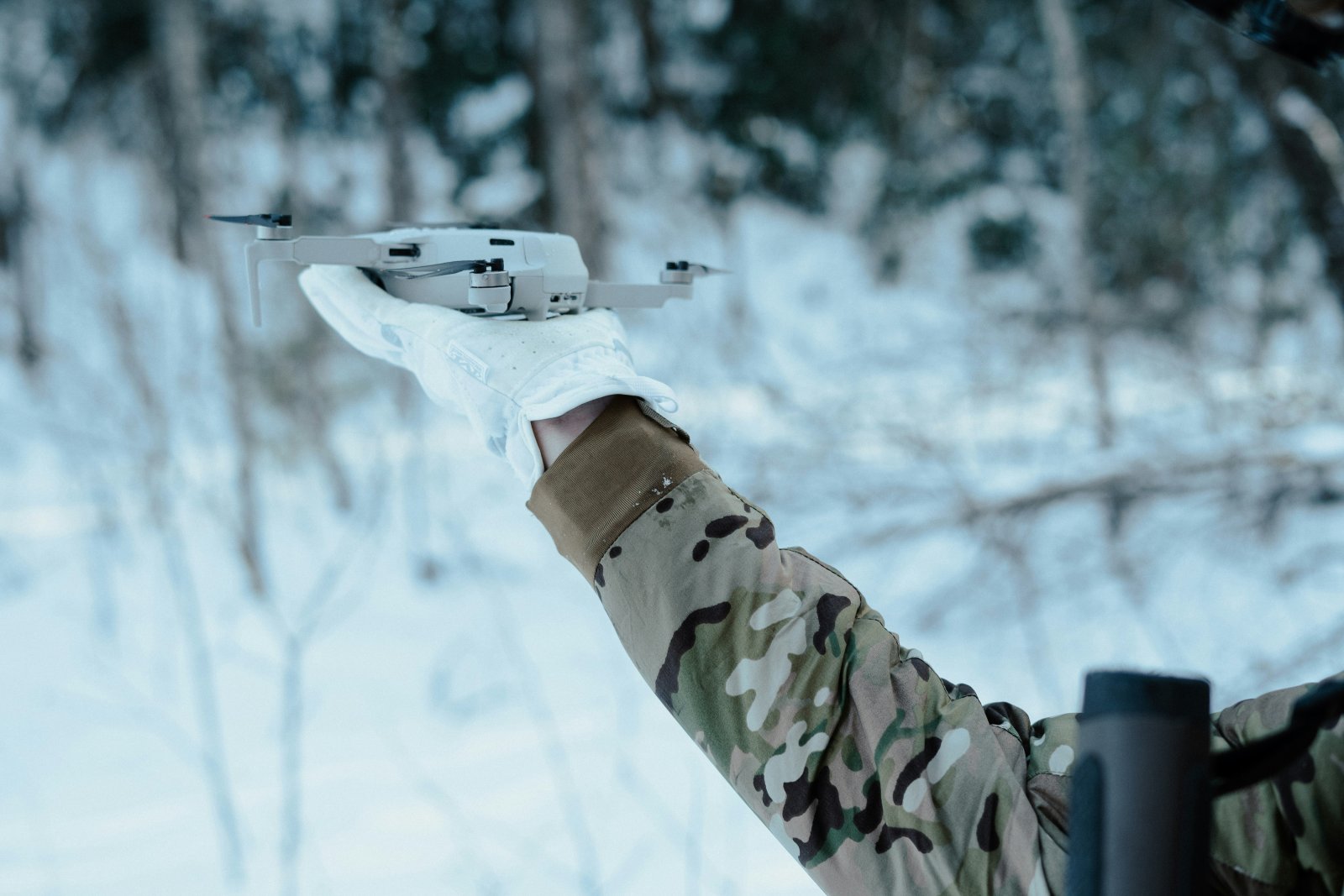
One reason drones have become so important is surprisingly simple: they can put sensors closer to the battlefield without putting another human being in the aircraft.
A small reconnaissance drone can fly over an area, transmit video and help troops understand what is happening beyond their immediate line of sight. That information can then be used to support other military systems.
This has created what military analysts increasingly describe as a sensor-to-shooter connection.
A drone detects something. Another system processes the information. A decision is made. An attack can then follow.
The separation between reconnaissance and attack is becoming less obvious as well. The Australian Army Research Centre notes that FPV drones are increasingly being used for both intelligence, surveillance and reconnaissance and strike missions, creating what it calls a “reconnaissance-strike complex.”
That changes the battlefield because finding a target can increasingly mean being able to engage it soon afterwards.
The technology itself does not have to be extraordinarily expensive.
Commercial electronics, cameras, batteries, radio systems, navigation hardware and increasingly sophisticated software can be combined into unmanned systems. That has lowered the barrier to producing and modifying certain types of military drones.
Ukraine's experience has demonstrated how quickly this ecosystem can scale.
A 2025 analysis by the Royal United Services Institute reported that Ukrainian drone production had expanded dramatically, estimating production at more than 2.2 million drones in 2024, with projections of 4.5 million in 2025. RUSI also highlighted an important vulnerability: many critical components were sourced from outside Ukraine, particularly from China.
That reveals another side of drone warfare.
The battle is not only happening in the sky.
It is also happening in factories, electronics supply chains, software development labs and workshops where damaged systems are repaired or modified.
A drone can be relatively cheap compared with a fighter aircraft, missile system or armoured vehicle. That creates an unusual economic calculation.
If a low-cost unmanned system can force an opponent to use a much more expensive defensive weapon, the exchange can become financially significant even when the drone itself is destroyed.
This does not mean drones have made traditional military equipment obsolete.
Far from it.
RUSI has warned against treating drones as a replacement for conventional firepower, pointing out that Ukraine's battlefield experience shows both the growing importance of unmanned systems and the limitations of relying on them too heavily. Modern warfare still involves artillery, air defence, electronic warfare, armour, infantry, logistics and other capabilities working together.
What drones have done is change how those systems interact.
A military unit that previously had limited visibility beyond its immediate position can now use unmanned aircraft to extend its awareness. Artillery and other weapons can then benefit from better information.
That creates a battlefield where information itself becomes a weapon.
Electronic warfare has consequently become an increasingly important part of the drone fight.
A drone depends on some combination of communications, navigation and control systems. Disrupt those systems and the aircraft can become much less effective.
This has created a technological race between drones and the systems designed to defeat them.
Ukraine's defence innovation ecosystem, for example, has been testing FPV drones designed to continue performing missions under electronic-warfare conditions. In April 2026, Ukraine's Brave1 defence innovation cluster said some newly tested FPV systems had demonstrated operations at ranges of up to 25 kilometres while exposed to electronic warfare.
The British Army is responding to the same problem from another direction.
Its recent drone training has placed greater emphasis on manual flying and operating without GPS or automated assistance, reflecting lessons from environments where electronic warfare can interfere with navigation and communications.
That is an important lesson about military technology: the smarter a system becomes, the more important it can be to understand how it behaves when its smartest features stop working.
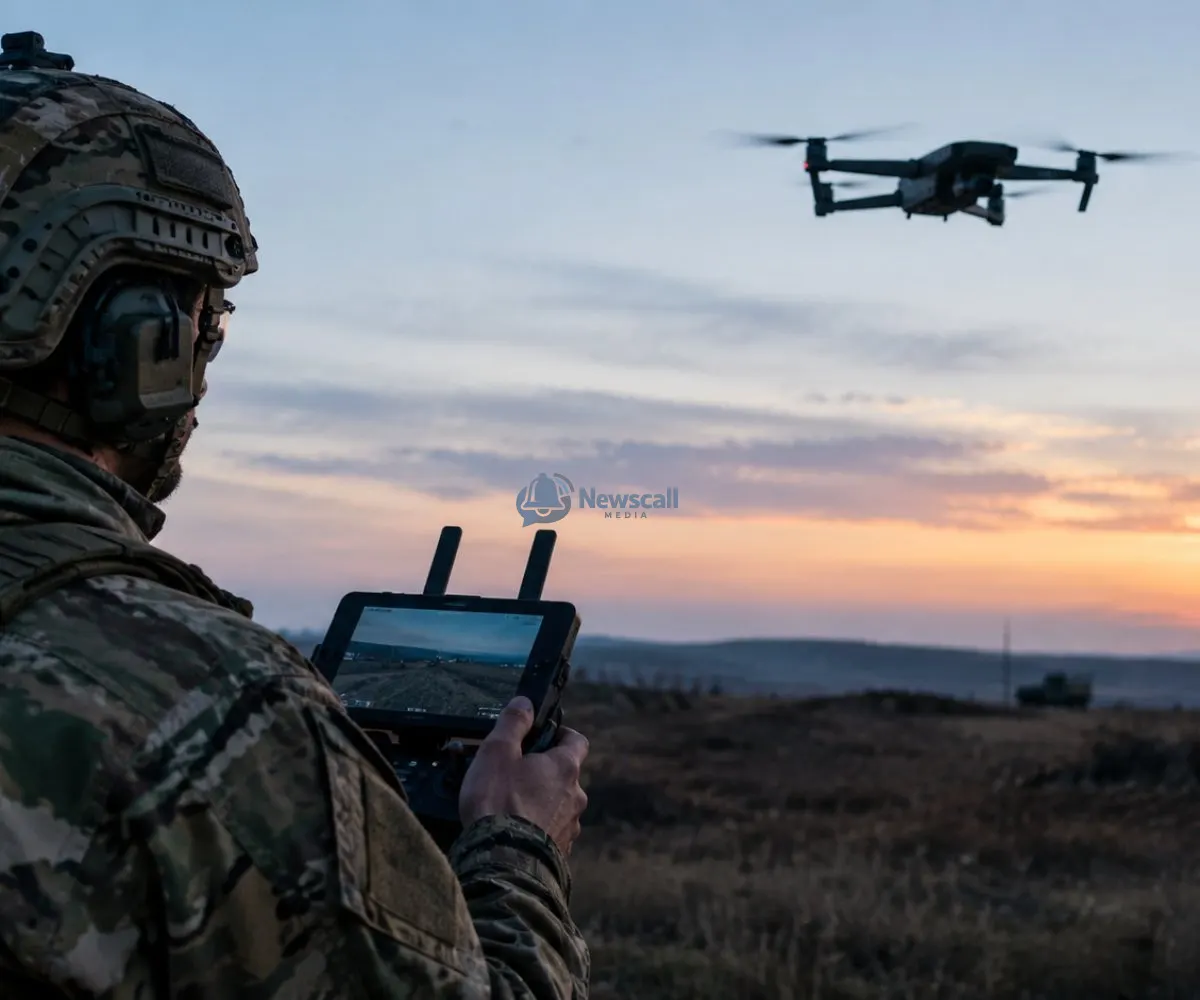
[IMAGE: Soldier operating a drone controller while monitoring a live aerial feed]
The drone battlefield is also moving beyond small quadcopters.
Long-range unmanned aircraft are being used for attacks far beyond the immediate frontline. Ukraine has developed a large ecosystem of long-range drones, while Russia has expanded its own production and deployed increasingly sophisticated systems.
Ukraine's defence ministry said in May 2026 that its forces were expanding the use of mid-range strike drones capable of operating at distances ranging from tens to hundreds of kilometres. These systems are intended to target assets such as air-defence systems, radars, command posts, warehouses and logistics infrastructure.
At the other end of the spectrum, tiny FPV drones are being used much closer to the frontline.
The result is an increasingly layered drone ecosystem.
Small systems can watch and strike near the front. Larger aircraft can operate farther away. Long-range systems can reach strategic targets. Ground robots are also entering the battlefield for tasks that would otherwise expose soldiers to danger.
Ukraine's defence ministry said in March 2026 that it was expanding the supply of FPV, reconnaissance, bomber and other unmanned systems to frontline brigades while also scaling unmanned ground vehicles.
The next major change may come from artificial intelligence.
Today, many drones still depend heavily on human operators. But AI is increasingly being used to assist with navigation, object recognition and target identification.
In September 2026, reporting on the Russia-Ukraine conflict described efforts to give drones greater autonomous capabilities, including systems designed to continue parts of their missions when communications with an operator are lost.
Britain is also now allowing defence companies to use battlefield data from Ukraine to develop AI models for drone swarms, illustrating how lessons from the conflict are feeding directly into the next generation of unmanned systems.
That development could be significant because communications are one of the vulnerabilities of remotely controlled systems.
If a drone can perform more of its mission without continuously receiving instructions, disrupting the operator's connection may become less effective.
But autonomy introduces another difficult question: how much decision-making should be handed to a machine in a combat environment?
That question goes beyond hardware.
It involves software reliability, identification, human oversight, international law and the risk of systems making mistakes in complicated environments.
Meanwhile, countries are investing heavily in technologies designed to stop drones.
The United States, for example, announced nearly $7 billion in enterprise contracts in September 2026 covering counter-drone technologies, including systems intended to detect, disable and destroy unmanned aircraft. The approach emphasizes layered defence because no single technology can counter every type of drone.
That creates another technological arms race.
Better drones lead to better counter-drone systems.
Better countermeasures encourage new drone designs.
Those designs create new requirements for electronic warfare, sensors and air defence.
And the cycle continues.
[IMAGE: Drone and counter-drone systems illustrated in a modern military environment]
The biggest lesson from the drone revolution may therefore have little to do with drones themselves.
It is about speed.
Military technology used to be associated with long development cycles and extremely expensive platforms. Drone warfare is demonstrating what happens when hardware, software and battlefield feedback can be modified much faster.
A drone can be redesigned.
A component can be replaced.
Software can be updated.
A new design can be tested.
The resulting system can return to the battlefield and generate another round of information.
RUSI has described this rapid adaptation as one of the defining characteristics of the Ukraine conflict, while warning that battlefield-specific innovations should not automatically be copied by other militaries without considering their own operational requirements.
That may be the most important reason drones have become such a major part of modern warfare.
They are not simply flying cameras or inexpensive weapons.
They are platforms for combining sensors, communications, software, artificial intelligence, electronics and weapons into systems that can be rapidly adapted.
The modern battlefield is consequently becoming more transparent, more connected and more contested at the same time.
Soldiers may have better visibility than ever before, but the enemy can have it too.
A drone can reveal a position, while another drone can be searching for the aircraft doing the observing.
Electronic warfare can disrupt communications.
Air defences can bring unmanned aircraft down.
AI can help a drone continue operating.
And counter-drone systems are being developed specifically to stop the next generation.
What began as an extension of military reconnaissance has therefore evolved into something much bigger.
Drones are becoming part of the battlefield's nervous system.
They see, communicate, locate, track and increasingly act.
And as militaries learn to combine them with AI, electronic warfare, ground robots and conventional weapons, the technology is likely to influence not only how future wars are fought, but also how military forces are designed in the first place.

Victor Oluebubechukwu Akuma.
Creative writer