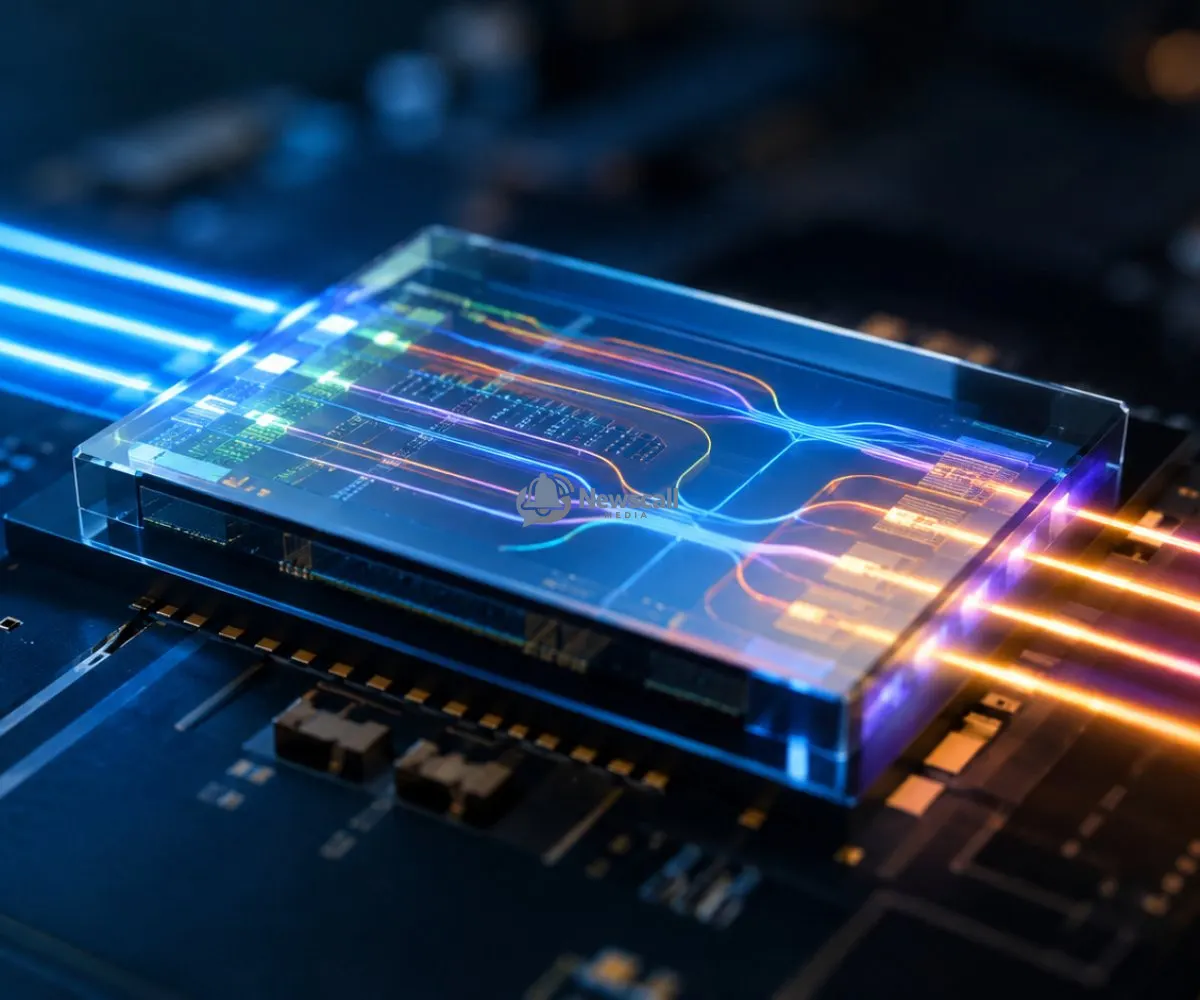
Could Computers Eventually Use Light Instead of Electricity to Process Information?
For most of the history of modern computing, electricity has been the language of machines.
A processor receives electrical signals, moves electrons through tiny circuits and uses those movements to represent and manipulate information. Billions of transistors can now fit onto a single chip, allowing computers to perform extraordinary numbers of calculations every second.
But as artificial intelligence models become larger and more demanding, researchers are looking at a very different possibility.
What if some computers could process information using light instead of relying primarily on electricity?
That is the idea behind photonic, or optical, computing.
Rather than moving information through electrical signals alone, photonic systems use particles of light called photons. Researchers believe this approach could eventually make certain types of computing significantly faster and more energy efficient, particularly the enormous mathematical operations required by artificial intelligence.
It sounds futuristic, but photonic computing is no longer purely theoretical. Researchers have already built experimental processors and photonic neural networks capable of performing useful AI workloads.
The reason light is interesting is that it behaves very differently from electrical current.
Light can travel extremely quickly, can carry enormous amounts of information and can travel through optical channels with relatively low losses over suitable distances. Multiple wavelengths of light can also travel through the same optical pathway, creating opportunities to process or transmit several streams of information simultaneously.
That last property is particularly interesting for AI.
Modern AI systems perform huge numbers of mathematical operations, especially matrix multiplications. These calculations are at the heart of neural networks used for everything from image recognition to large language models.
Electronic processors can perform these operations extremely quickly, but moving data between different parts of a computing system consumes energy and takes time.
This is becoming a major problem as AI systems grow.
A 2026 review in Nature Photonics noted that photonic accelerators are increasingly being investigated for AI because of their potential advantages in energy efficiency, compute throughput, density and latency. At the same time, the researchers highlighted major obstacles involving optical losses, electro-optical interfaces, scalability and the difficulty of creating efficient nonlinear optical components.
This is where photonics gets interesting.
Instead of representing every calculation through electrical switching, a photonic processor can manipulate properties of light such as its intensity and phase.
Optical components can be arranged so that light passing through them is transformed in a way that represents a mathematical operation.
Think of it somewhat like water flowing through a complicated system of pipes.
Changing the shape and arrangement of the pipes changes how the water behaves. In a photonic processor, carefully designed optical components control how light interacts, interferes and changes as it travels through the chip.
The result can represent a calculation.
Researchers are particularly interested in using this behaviour for neural networks because some of the operations performed by AI models map naturally onto optical systems.
That is why photonic AI has become one of the more active areas of computing research.
A 2025 review published in npj Nanophotonics described photonic neural networks as promising because photons can provide high bandwidth, low latency, low energy consumption and substantial parallelism. Researchers are now working to integrate the necessary optical components onto increasingly compact chips rather than relying on large laboratory setups.
The word parallelism is important here.
Imagine having to perform 1,000 calculations.
A conventional system might process them through electronic circuits using highly optimized architectures. An optical system can potentially encode many values into different properties of light and process them simultaneously as the light travels through the chip.
Different wavelengths can also carry separate channels of information.
In principle, that means a single optical pathway could handle multiple calculations at the same time.
Researchers are already demonstrating versions of this idea.
A 2025 Nature paper reported an integrated large-scale photonic accelerator designed for ultra-low-latency computation. Another study published in Nature described a universal photonic AI processor that achieved near-electronic precision for many workloads, demonstrating that photonic systems are beginning to compete with conventional electronic AI accelerators in specific applications.
That does not mean someone is about to replace the processor inside a laptop with a glass chip.
There is a major difference between demonstrating a technology in a research environment and building an affordable, reliable computer that millions of people can use.
One of the biggest problems is that computers do not only perform calculations.
They have to store information, move data, control processes and communicate with other components.
A photonic processor might perform a mathematical operation extremely efficiently, but the data still has to get into the optical system and eventually return to electronic hardware for many tasks.
That creates a problem known as the electro-optical interface.
Converting electrical signals into optical signals and converting them back again consumes energy and adds complexity.
If too much information has to repeatedly cross between electronics and photonics, some of the advantages of using light can disappear.
Researchers therefore aren't simply trying to build computers made entirely from light.
A more realistic near-term future is likely to involve hybrid systems, where electronics and photonics each handle the jobs they are best suited for.
Electronics could continue handling general-purpose computing, memory and control, while photonic components accelerate specific operations such as AI inference or high-bandwidth data movement.
This approach is already attracting commercial interest.
Companies working on photonic technology are developing optical interconnects designed to help AI data centers move enormous quantities of information between processors. Lightmatter, for example, has been developing photonic interconnect technology for AI infrastructure and in 2026 joined initiatives involving NVIDIA's NVLink Fusion and the Open Compute Project's work on co-packaged optics.
That application may actually arrive before fully optical general-purpose computers.
AI data centers are struggling with the sheer amount of information that has to move between processors.
A powerful AI accelerator is only useful if it can receive data quickly enough.
As AI clusters grow, communication between chips can become a significant part of the system's energy and performance problem. Optical connections can potentially move large quantities of data with lower energy costs and higher bandwidth than conventional electrical connections over appropriate distances.
This makes photonics attractive even if the actual mathematical processing remains partly electronic.
Meanwhile, researchers are pushing the technology further.
A 2026 Nature Communications study described a photonic mixture-of-experts architecture designed to scale AI workloads by using multiple optical computing cores. The researchers reported a chip with 18 parallel kernels and an average 97.1% accuracy across its demonstrated multi-domain image-classification tasks.
Another 2026 study reported an optoelectronic processor achieving 65.04 trillion operations per second while combining several forms of optical parallelism.
Numbers like these are impressive, but they need context.
Laboratory performance figures do not automatically translate into a faster or cheaper computer in the real world. Researchers have to account for the entire system, including lasers, detectors, memory, data conversion, cooling, packaging and software.
There is also the problem of optical nonlinearity.
Neural networks do not consist entirely of simple mathematical operations. They also require nonlinear functions, and implementing these efficiently in the optical domain remains difficult.
A 2025 study in Nature Computational Science demonstrated a complete photonic integrated neuron using a silicon-nitride photonic chip, with the researchers reporting latency as low as 240 picoseconds for the demonstrated processing. Such experiments are important because building practical optical neural networks requires more than simply performing fast linear calculations.
The technology is therefore advancing on several fronts simultaneously.
Some researchers are improving photonic processors.
Others are working on optical memory, lasers, detectors and packaging.
Some are focusing on connecting conventional electronic processors with optical networks, while others are exploring systems designed specifically for AI.
There is no guarantee that photonic computing will replace electronic computing.
It may not need to.
The more realistic possibility is that light becomes another fundamental tool inside future computers.
Your next AI data center may still contain conventional CPUs and GPUs. It may still use electronic memory and electronic control systems. But somewhere between those components, light could be carrying information at enormous speeds or performing calculations that would otherwise consume significant electrical power.
That would make photonic computing less of a replacement for electronics and more of an evolution of the computer itself.
The biggest opportunity may come as AI continues to demand more computation.
Today's electronic processors are extraordinarily capable, but increasing AI workloads are putting pressure on energy consumption, bandwidth and data movement. Recent research in Nature Nanotechnology and Nature Photonics points to photonics as one possible route toward handling some of that demand more efficiently, while also emphasizing that significant engineering challenges remain.
So, could computers eventually use light instead of electricity to process information?
For some kinds of computing, they already can.
The bigger question is how far the technology can scale.
If researchers can solve the problems surrounding optical memory, nonlinear processing, manufacturing, reconfigurability and the conversion between electrical and optical signals, future computing systems could use something that has been around for billions of years in a completely new way.
Light may not replace electricity inside computers.
But it could become one of the most important things travelling through them.

Victor Oluebubechukwu Akuma.
Creative writer